
By Aparna S, Student Intern at Saamuhika Shakti (May to July 2025); Ekta Sawant, Communications Manager, Saamuhika Shakti
A Settlement at the Margins of Growth
In the eastern stretch of Bengaluru, Vinayaka Nagar sits at the edge of a rapidly expanding city. Apartment complexes rise nearby, roads widen, and infrastructure continues to grow. Yet, within one corner of this neighbourhood lies a settlement that tells a different story.
Half-finished strips of woven coconut leaves mark its entrance. Homes made of tarpaulin sheets and repurposed banners form a patchwork landscape. This is home to a small community of hair pickers and waste pickers, families who have lived and worked here for decades.
The settlement is located on low-lying land near a lake, making it especially vulnerable during the monsoon. Reports on urban vulnerability in Bengaluru have highlighted how such informal settlements often face repeated flooding, poor drainage, and exposure to contaminated water. In Vinayaka Nagar, this translates into water entering homes, damaged belongings, and heightened health risks. Basic services remain inconsistent. The area is non-notified, which means it lacks formal access to electricity and other essential infrastructure.
Despite these constraints, the community has continued to build a life here through shared effort and mutual support.
%20(1)%20(1)%20(1).jpg)
Work That Never Stops
For the women of Vinayaka Nagar, work follows a steady rhythm. Their day begins at six in the morning and often stretches until evening. Carrying sacks of utensils weighing up to ten kilograms, they travel across the city, from Banashankari to KR Market, exchanging these utensils for human hair.
Tuesdays and Fridays are considered days off, but only in name. These are days spent indoors sorting, cleaning, and preparing the collected hair for sale.
.jpg)
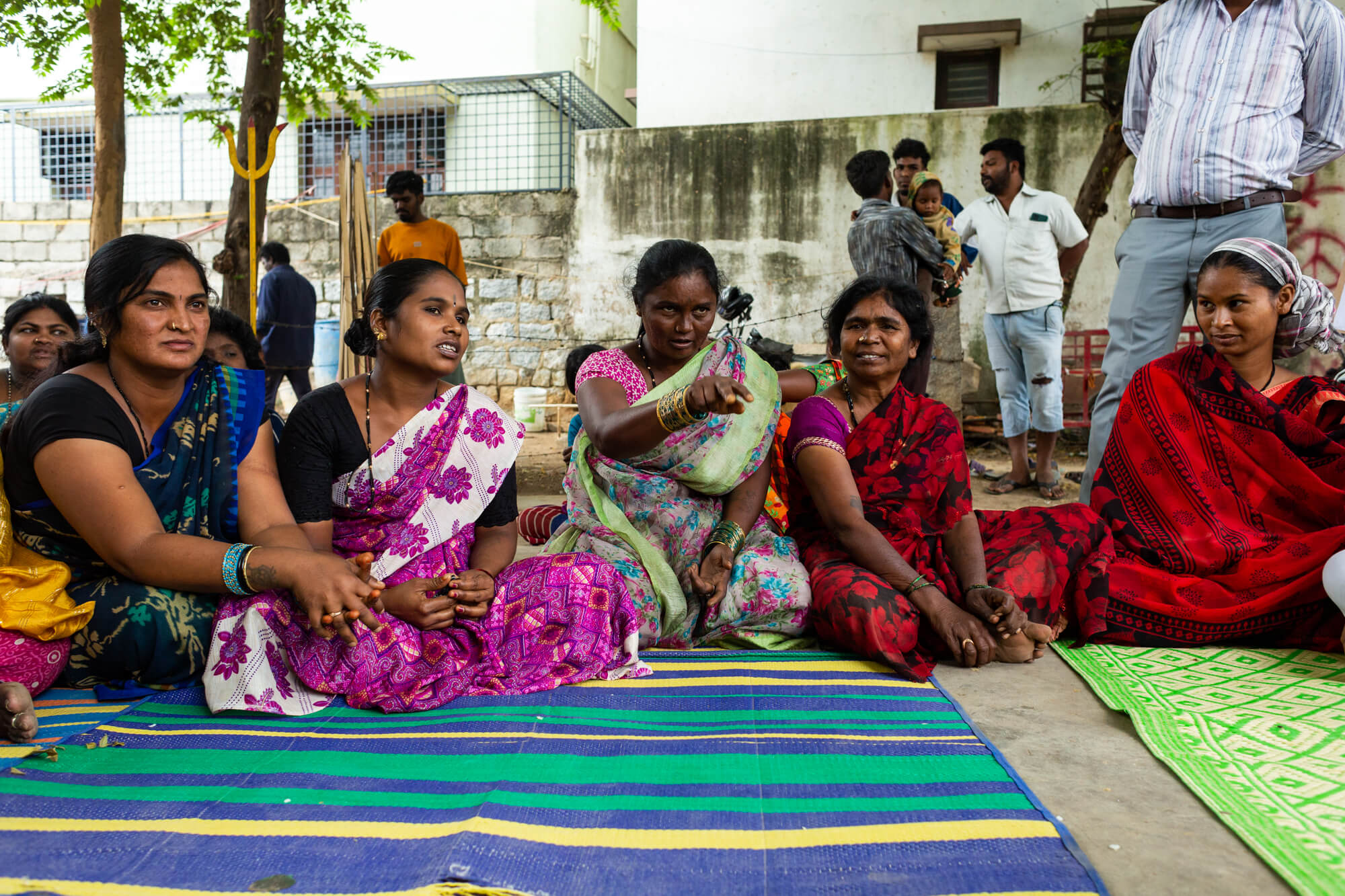
On one such morning in July 2025, we sat with three women together in front of a small temple shaded by trees. Lakshmi, Meena, and Savitri use this time to talk. Their conversation moves between routine and reflection, touching upon aspirations, struggles, and small shifts in their lives.
Their routines are nearly identical. What differs are the personal realities they carry. Lakshmi and Meena speak of their desire to have children, a longing that quietly shapes how they think about their savings and future. Savitri, a mother of four, hopes instead that her daughters will have access to education and opportunities that she did not.
Histories of Migration and Collective Living
Savitri, one of the older residents, has lived in Vinayaka Nagar for nearly three decades. She recalls a time when the area was surrounded by eucalyptus trees, with very few homes and frequent encounters with snakes. The land was unclean and built along a drain.
Over time, it was the collective effort of residents that transformed it into a liveable settlement. “We all came together and stayed together,” she reflects.
Her own journey into hair picking comes from her family. Her father made hair extensions, and she learnt the skill early on. Like many others in the community, her family moved frequently in search of work before eventually settling here.
These shared histories of migration and labour form the foundation of the community’s cohesion today.
.jpg)
Livelihoods in Transition
Hair picking remains the primary occupation for most families. However, it is seasonal and requires time to accumulate enough material for sale. In the interim, community members engage in other forms of trade to maintain a steady income.
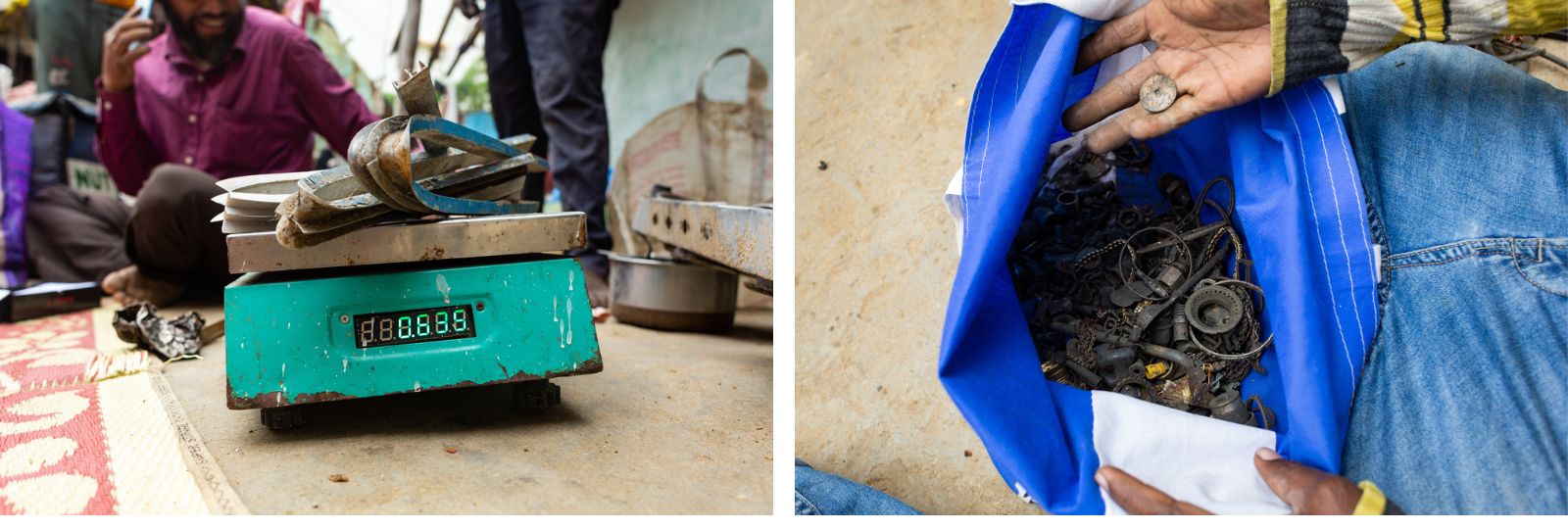
Some have begun dealing in artificial jewellery, while others trade in recyclable materials such as copper wires, iron sheets, and construction waste. Traditional practices continue as well, including making toys from gum-resin, particularly during festival seasons when demand increases.
There is also a small but steady practice of reselling metal utensils in local weekly markets. This diversification reflects both necessity and adaptability, enabling households to manage income fluctuations. Some also take up choultry work when possible.
.jpg)
Securing Identity, Accessing Rights
For many years, residents lived and worked without formal identity documents. This limited their access to welfare schemes, financial services, and even basic mobility.
Through sustained efforts by Hasiru Dala, community members have been able to secure essential documentation including Aadhaar, ration cards, voter IDs, PAN cards, e-Shram cards, and caste and income certificates. The Ambedkar Sahaya Hasta and e-Shram cards, in particular, have provided recognition as informal sector workers.
This shift has had tangible effects. Ration cards are now used regularly, even though long queues remain a challenge. Aadhaar has enabled access to the Shakti Scheme, allowing free bus travel. For women who once walked long distances carrying heavy loads, this has reduced physical strain and freed up small amounts of money for daily needs such as food and tea.
For Savitri, who has undergone surgery and finds walking difficult, this change has been especially significant.
%20(1)%20(1)%20(1).jpg)
Living Conditions and Incremental Improvements
Housing remains one of the most pressing challenges. Tarpaulin roofs offer limited protection, particularly during heavy rains. Flooding continues to disrupt daily life.
Vinayaka Nagar has faced recurring flooding in recent years. During a similar incident in May 2025, Hasiru Dala stepped in to support the community in addressing the situation. In the absence of adequate municipal response the previous year, residents had collectively taken the initiative to dig a canal to redirect excess water into the nearby rajakaluve (stormwater drain). Building on this effort, the canal has since been rebuilt and strengthened, helping to reduce the severity of flooding compared to earlier instances.
In the absence of grid electricity, solar lighting solutions have been introduced with support from Hasiru Dala. While earlier installations were damaged by floods, they have since been replaced with more secure fittings. These lights have made a visible difference, particularly for children who can now study after dark without relying on candles.
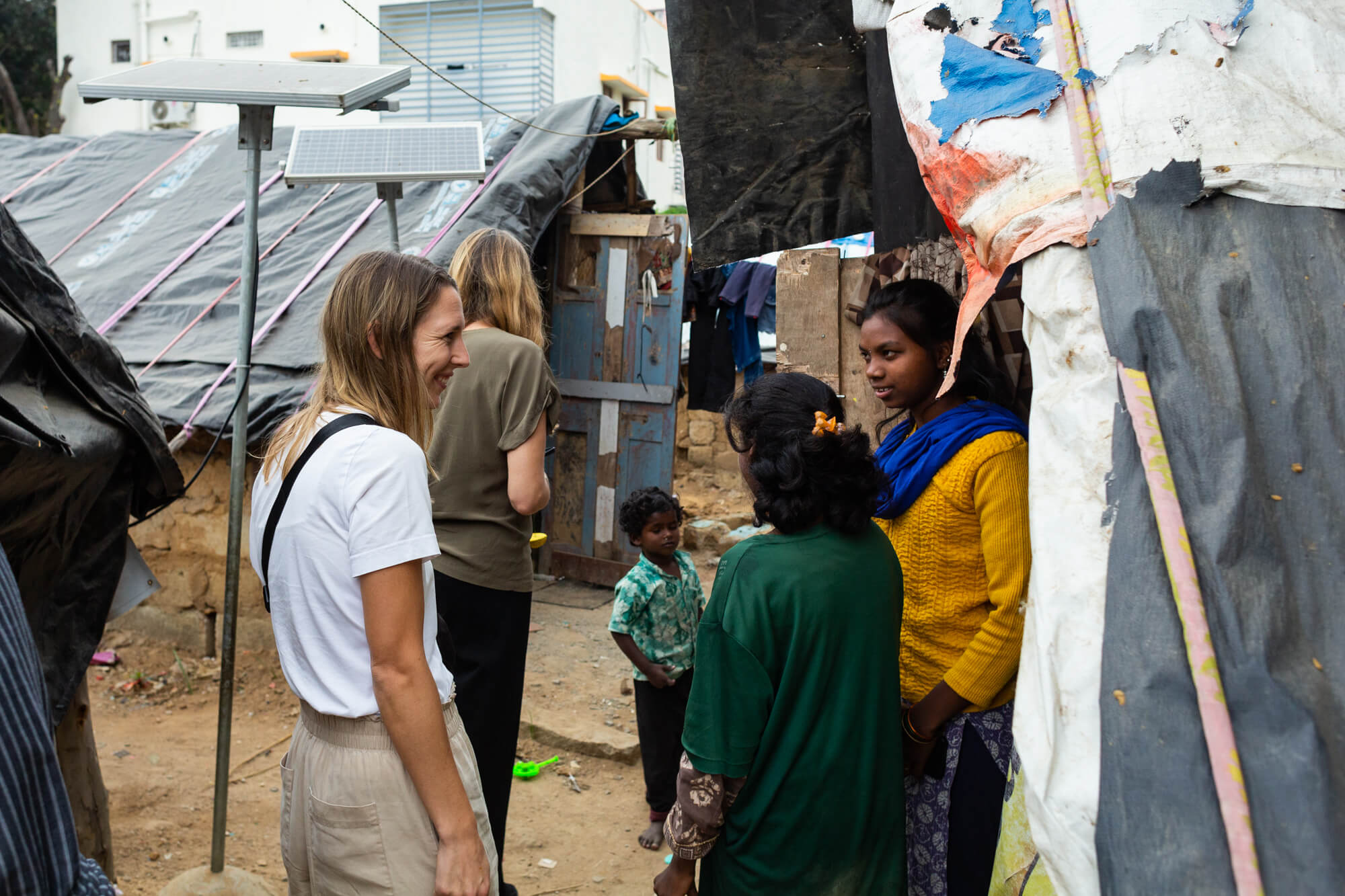
Tarpaulins distributed through programme support, often repurposed from event materials, have also helped reinforce homes.
At a Namma Jagali (community meeting) held in November 2025, housing concerns were discussed in depth. While long-term solutions are being explored, interim measures such as mobile toilets were suggested. However, these come with their own challenges, particularly around maintenance and sanitation, as waste disposal continues to impact the surrounding environment.
.jpg)
Building Collective Strength Through Groups
A key development in the locality has been the formation of self-help groups. With support from CARE India in the first phase, women in the community formed the Mallige Self Help Group, now led by Lakshmi.
The group currently has 13 members. Each contributes ₹100 weekly, with discussions underway to increase contributions. Over time, the group has built a fixed deposit of ₹2.5 lakh and maintains additional savings in its account. Individual savings have also grown, reaching levels that once seemed unattainable.
In the second phase, Sambhav Foundation continues to support these efforts, strengthening financial practices and group cohesion.
The presence of the SHG has done more than enable savings. It has created a shared sense of purpose and possibility. For many, it represents the first step towards financial stability and collective agency.
Learning, Awareness, and Shifts in Aspiration
Training programmes on digital literacy, financial management, gender-based violence, and leadership have been introduced over time.
Lakshmi and Meena have learnt to use digital payment platforms, an increasingly necessary skill as transactions shift online. Being able to accept payments through mobile applications has directly impacted their work. At the same time, gaps remain, with some members still unfamiliar with these tools.
Community members also participate in awareness sessions conducted by Sparsha Trust, particularly around child marriage. These sessions, often delivered through performances, have resonated deeply. Many women reflect on their own early marriages and express a clear desire for a different future for their children.
Expanding Possibilities
Beyond their current work, the women of Vinayaka Nagar are exploring new livelihood options. Lakshmi is interested in starting a utensils business, Meena hopes to run a fruit cart, and Savitri has experimented with soap-making. Recent training in bag-making has also generated interest.
While these aspirations are still evolving, they reflect a shift from survival to possibility.
Support systems have also extended into more personal aspects of life. For women like Lakshmi and Meena, who hope to have children, access to information and guidance on options such as IVF has been an important form of emotional and practical support.
Collaboration as a Foundation for Change
The story of Vinayaka Nagar is not one of transformation through a single intervention. It is a story of layered, collaborative effort. Community members, civil society organisations, and programme partners have each played a role in shaping incremental change.
From securing identity documents to building savings, from accessing mobility to participating in collective forums, the shifts are visible, even if uneven. Challenges around housing, sanitation, and infrastructure remain significant. Yet, there is a growing sense of stability and belief in the future.
What stands out most is the role of collaboration. It is present in the way the community first built the settlement together, and in how they continue to engage with partners and each other today.
In Vinayaka Nagar, collaboration is not an abstract idea. It is a lived practice that, over time, has helped the community move from uncertainty towards a more secure and hopeful future.
This case study, prepared by Aparna S, a student of MA Economics at Azim Premji University during her internship with Saamuhika Shakti from May to July 2025, is part of the collective’s ongoing commitment to spotlighting the voices and lived experiences of informal waste pickers and their families, in order to strengthen collective impact in Bengaluru.
By Aparna S, Student Intern at Saamuhika Shakti (May to July 2025); Ekta Sawant, Communications Manager, Saamuhika Shakti
A Settlement at the Margins of Growth
In the eastern stretch of Bengaluru, Vinayaka Nagar sits at the edge of a rapidly expanding city. Apartment complexes rise nearby, roads widen, and infrastructure continues to grow. Yet, within one corner of this neighbourhood lies a settlement that tells a different story.
Half-finished strips of woven coconut leaves mark its entrance. Homes made of tarpaulin sheets and repurposed banners form a patchwork landscape. This is home to a small community of hair pickers and waste pickers, families who have lived and worked here for decades.
The settlement is located on low-lying land near a lake, making it especially vulnerable during the monsoon. Reports on urban vulnerability in Bengaluru have highlighted how such informal settlements often face repeated flooding, poor drainage, and exposure to contaminated water. In Vinayaka Nagar, this translates into water entering homes, damaged belongings, and heightened health risks. Basic services remain inconsistent. The area is non-notified, which means it lacks formal access to electricity and other essential infrastructure.
Despite these constraints, the community has continued to build a life here through shared effort and mutual support.
Work That Never Stops
For the women of Vinayaka Nagar, work follows a steady rhythm. Their day begins at six in the morning and often stretches until evening. Carrying sacks of utensils weighing up to ten kilograms, they travel across the city, from Banashankari to KR Market, exchanging these utensils for human hair.
Tuesdays and Fridays are considered days off, but only in name. These are days spent indoors sorting, cleaning, and preparing the collected hair for sale.
On one such morning in July 2025, we sat with three women together in front of a small temple shaded by trees. Lakshmi, Meena, and Savitri use this time to talk. Their conversation moves between routine and reflection, touching upon aspirations, struggles, and small shifts in their lives.
Their routines are nearly identical. What differs are the personal realities they carry. Lakshmi and Meena speak of their desire to have children, a longing that quietly shapes how they think about their savings and future. Savitri, a mother of four, hopes instead that her daughters will have access to education and opportunities that she did not.
Histories of Migration and Collective Living
Savitri, one of the older residents, has lived in Vinayaka Nagar for nearly three decades. She recalls a time when the area was surrounded by eucalyptus trees, with very few homes and frequent encounters with snakes. The land was unclean and built along a drain.
Over time, it was the collective effort of residents that transformed it into a liveable settlement. “We all came together and stayed together,” she reflects.
Her own journey into hair picking comes from her family. Her father made hair extensions, and she learnt the skill early on. Like many others in the community, her family moved frequently in search of work before eventually settling here.
These shared histories of migration and labour form the foundation of the community’s cohesion today.
Livelihoods in Transition
Hair picking remains the primary occupation for most families. However, it is seasonal and requires time to accumulate enough material for sale. In the interim, community members engage in other forms of trade to maintain a steady income.
Some have begun dealing in artificial jewellery, while others trade in recyclable materials such as copper wires, iron sheets, and construction waste. Traditional practices continue as well, including making toys from gum-resin, particularly during festival seasons when demand increases.
There is also a small but steady practice of reselling metal utensils in local weekly markets. This diversification reflects both necessity and adaptability, enabling households to manage income fluctuations. Some also take up choultry work when possible.
Securing Identity, Accessing Rights
For many years, residents lived and worked without formal identity documents. This limited their access to welfare schemes, financial services, and even basic mobility.
Through sustained efforts by Hasiru Dala, community members have been able to secure essential documentation including Aadhaar, ration cards, voter IDs, PAN cards, e-Shram cards, and caste and income certificates. The Ambedkar Sahaya Hasta and e-Shram cards, in particular, have provided recognition as informal sector workers.
This shift has had tangible effects. Ration cards are now used regularly, even though long queues remain a challenge. Aadhaar has enabled access to the Shakti Scheme, allowing free bus travel. For women who once walked long distances carrying heavy loads, this has reduced physical strain and freed up small amounts of money for daily needs such as food and tea.
For Savitri, who has undergone surgery and finds walking difficult, this change has been especially significant.
Living Conditions and Incremental Improvements
Housing remains one of the most pressing challenges. Tarpaulin roofs offer limited protection, particularly during heavy rains. Flooding continues to disrupt daily life.
Vinayaka Nagar has faced recurring flooding in recent years. During a similar incident in May 2025, Hasiru Dala stepped in to support the community in addressing the situation. In the absence of adequate municipal response the previous year, residents had collectively taken the initiative to dig a canal to redirect excess water into the nearby rajakaluve (stormwater drain). Building on this effort, the canal has since been rebuilt and strengthened, helping to reduce the severity of flooding compared to earlier instances.
In the absence of grid electricity, solar lighting solutions have been introduced with support from Hasiru Dala. While earlier installations were damaged by floods, they have since been replaced with more secure fittings. These lights have made a visible difference, particularly for children who can now study after dark without relying on candles.
Tarpaulins distributed through programme support, often repurposed from event materials, have also helped reinforce homes.
At a Namma Jagali (community meeting) held in November 2025, housing concerns were discussed in depth. While long-term solutions are being explored, interim measures such as mobile toilets were suggested. However, these come with their own challenges, particularly around maintenance and sanitation, as waste disposal continues to impact the surrounding environment.
Building Collective Strength Through Groups
A key development in the locality has been the formation of self-help groups. With support from CARE India in the first phase, women in the community formed the Mallige Self Help Group, now led by Lakshmi.
The group currently has 13 members. Each contributes ₹100 weekly, with discussions underway to increase contributions. Over time, the group has built a fixed deposit of ₹2.5 lakh and maintains additional savings in its account. Individual savings have also grown, reaching levels that once seemed unattainable.
In the second phase, Sambhav Foundation continues to support these efforts, strengthening financial practices and group cohesion.
The presence of the SHG has done more than enable savings. It has created a shared sense of purpose and possibility. For many, it represents the first step towards financial stability and collective agency.
Learning, Awareness, and Shifts in Aspiration
Training programmes on digital literacy, financial management, gender-based violence, and leadership have been introduced over time.
Lakshmi and Meena have learnt to use digital payment platforms, an increasingly necessary skill as transactions shift online. Being able to accept payments through mobile applications has directly impacted their work. At the same time, gaps remain, with some members still unfamiliar with these tools.
Community members also participate in awareness sessions conducted by Sparsha Trust, particularly around child marriage. These sessions, often delivered through performances, have resonated deeply. Many women reflect on their own early marriages and express a clear desire for a different future for their children.
Expanding Possibilities
Beyond their current work, the women of Vinayaka Nagar are exploring new livelihood options. Lakshmi is interested in starting a utensils business, Meena hopes to run a fruit cart, and Savitri has experimented with soap-making. Recent training in bag-making has also generated interest.
While these aspirations are still evolving, they reflect a shift from survival to possibility.
Support systems have also extended into more personal aspects of life. For women like Lakshmi and Meena, who hope to have children, access to information and guidance on options such as IVF has been an important form of emotional and practical support.
Collaboration as a Foundation for Change
The story of Vinayaka Nagar is not one of transformation through a single intervention. It is a story of layered, collaborative effort. Community members, civil society organisations, and programme partners have each played a role in shaping incremental change.
From securing identity documents to building savings, from accessing mobility to participating in collective forums, the shifts are visible, even if uneven. Challenges around housing, sanitation, and infrastructure remain significant. Yet, there is a growing sense of stability and belief in the future.
What stands out most is the role of collaboration. It is present in the way the community first built the settlement together, and in how they continue to engage with partners and each other today.
In Vinayaka Nagar, collaboration is not an abstract idea. It is a lived practice that, over time, has helped the community move from uncertainty towards a more secure and hopeful future.
This case study, prepared by Aparna S, a student of MA Economics at Azim Premji University during her internship with Saamuhika Shakti from May to July 2025, is part of the collective’s ongoing commitment to spotlighting the voices and lived experiences of informal waste pickers and their families, in order to strengthen collective impact in Bengaluru.


