
How the daughter of a waste picker became a Common Service Centre operator, strengthening her community's ability to navigate public systems and claim their rights.
By Anupriya, Project Lead and Arpitha MV, Social Media Officer, Hasiru Dala
For many waste picker families in Bengaluru, accessing government welfare schemes can be far more complicated than it should be.
Applying for a pension, updating a ration card, securing a scholarship or obtaining a health ID often requires navigating multiple offices, digital portals and documentation requirements. For families working long hours in the informal economy, each visit can mean lost wages, additional expenses and considerable uncertainty. A waste picker shared:
“New Aadhar card or correction cost Rs 100 at a cyber cafe and still we didn’t get any assurance of receiving it even after 3-4 months. New PAN Card cost Rs 400/- with agents and time taken could be ~3 months or more. For Caste and Income certificate ~Rs 3500 is being asked by agents.”
Over the years, Hasiru Dala has worked alongside waste picker communities to address these barriers. Through its work on livelihoods, social security and community leadership, the organisation has seen how difficult it can be for families to access services and entitlements that are meant to support them.
This understanding informed the creation of a new Common Service Centre (CSC) in Shakambari Nagar/Banashankari.
The CSC was established with a simple but important idea: what if access to welfare schemes and digital services could be centered within the community and facilitated by people from the community itself?
At the centre of this effort is Saranya, a young woman of 26, a graduate in B.E. from the waste picker community who now operates the CSC and supports residents in accessing a range of government and digital services. An aspiring civil servant herself, she represents a growing cohort of young community leaders stepping into roles that were previously inaccessible to many.
Saranya’s journey with Hasiru Dala goes back several years. Her mother had been associated with the organisation through the livelihood programs and community initiatives, making Hasiru Dala a familiar presence throughout her childhood. Over the years, Saranya herself received support through educational scholarships that helped her continue her studies and also provided guidance and financial support for her civil service exam preparations.
Growing up in the community, Saranya had seen first-hand how difficult it could be for families to navigate government systems. Accessing even basic services often depended on having the right information, documents, digital skills and time.
"Families often end up paying agents or third parties to access services that are meant to be free. Some are overcharged. Others are misled or sent back repeatedly because of incomplete paperwork. A single missed document can mean weeks of delay. For daily wage workers, every lost day also means lost income."
When Hasiru Dala launched a pilot initiative to train young people from waste picker families in digital literacy, entrepreneurship, leadership and access to government services, Saranya was among those who stepped forward. The programme pilot in Bangalore brought together around 25 young people from waste picker communities, equipping them with practical skills while encouraging them to become local resource persons within their own neighbourhoods.
Since June 2025, participants have undergone four digital literacy training sessions covering digital tools, access to government services and community leadership. In addition, a dedicated training programme focused on Common Service Centre (CSC) operations and CSC examination preparation. Saranya actively participated in these trainings and received handholding support for the CSC exam process, administrative procedures among others, helping her build the skills and confidence to establish and operate the centre.
Today, Saranya runs the CSC. “We are establishing a CSC especially for waste pickers, so they can access services at a lower cost compared to others and benefit from them,” she says. Through the centre, community members can seek support for pensions, ration cards, scholarships, health IDs and other welfare schemes.
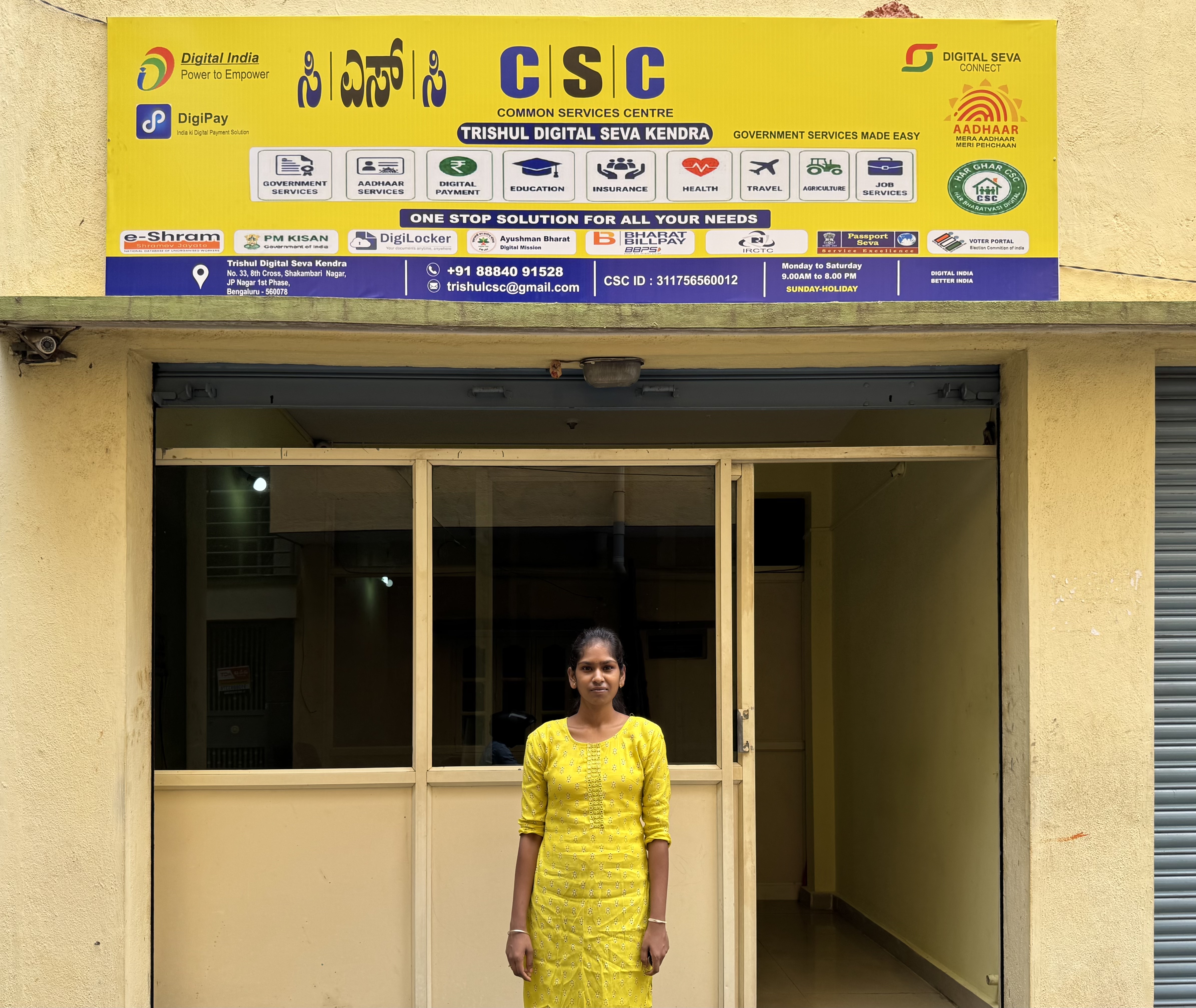
Among the most frequently requested services are applications for Udhyam registrations (government-issued digital certificates legally recognising micro, small and medium enterprises), caste and income certificates, voter IDs, PAN cards (identity cards issued by the Income Tax Department of India that are mandatory for all taxpayers), e-Shram registrations (a Government of India initiative to support unorganised workers, allowing them to access social security schemes, welfare benefits and government assistance), Ayushman Bharat cards (digital health ID cards issued by the Indian government, helping eligible beneficiaries access health insurance coverage) and residential certificates (domicile IDs). By providing these services within the community, the CSC is helping community members navigate government systems more easily while reducing both the cost and time involved in accessing essential documents and entitlements.
Yet the value of the CSC extends beyond service delivery.
For many residents, navigating government systems can be intimidating. Processes are often unfamiliar and information is not always easy to access. Having someone from the community provide support can make these interactions easier and more approachable.
Because the centre is operated by a community member, waste pickers know where to go for help. Questions can be asked without hesitation and information can be shared through relationships that already exist. In this way, the CSC functions not only as a service point but also as a trusted community resource.
Saranya's experience also highlights the importance of creating pathways for young people to take on leadership roles within their own communities.
Too often, discussions around marginalised communities focus on what people lack. The CSC offers a different perspective. It demonstrates how community members can become facilitators, problem-solvers and connectors when they are given access to training, resources and opportunities.
This approach is central to Hasiru Dala's vision for strengthening community agency and leadership, and expanding access to social security systems. As Nalini Shekar, Co-founder of Hasiru Dala, explains:
“It's a good day for Hasiru Dala and Saamuhika Shakti. Saranya, who is now aspiring for civil services, has started this CSC centre. Our goal is to build the agency of the community so that they can independently access social security systems. This is our first initiative of this kind. We hope to establish similar centres in every district, run by members of the community for their own community, so that access to social security can continue to expand.”
Saranya's role at the CSC reflects this broader aspiration. Rather than positioning community members solely as beneficiaries of support, the initiative invests in local leadership and equips young people with the skills, knowledge and confidence to help others navigate systems that are often difficult to access. The CSC pilot is expected to reach more than 500 community members across Bengaluru.
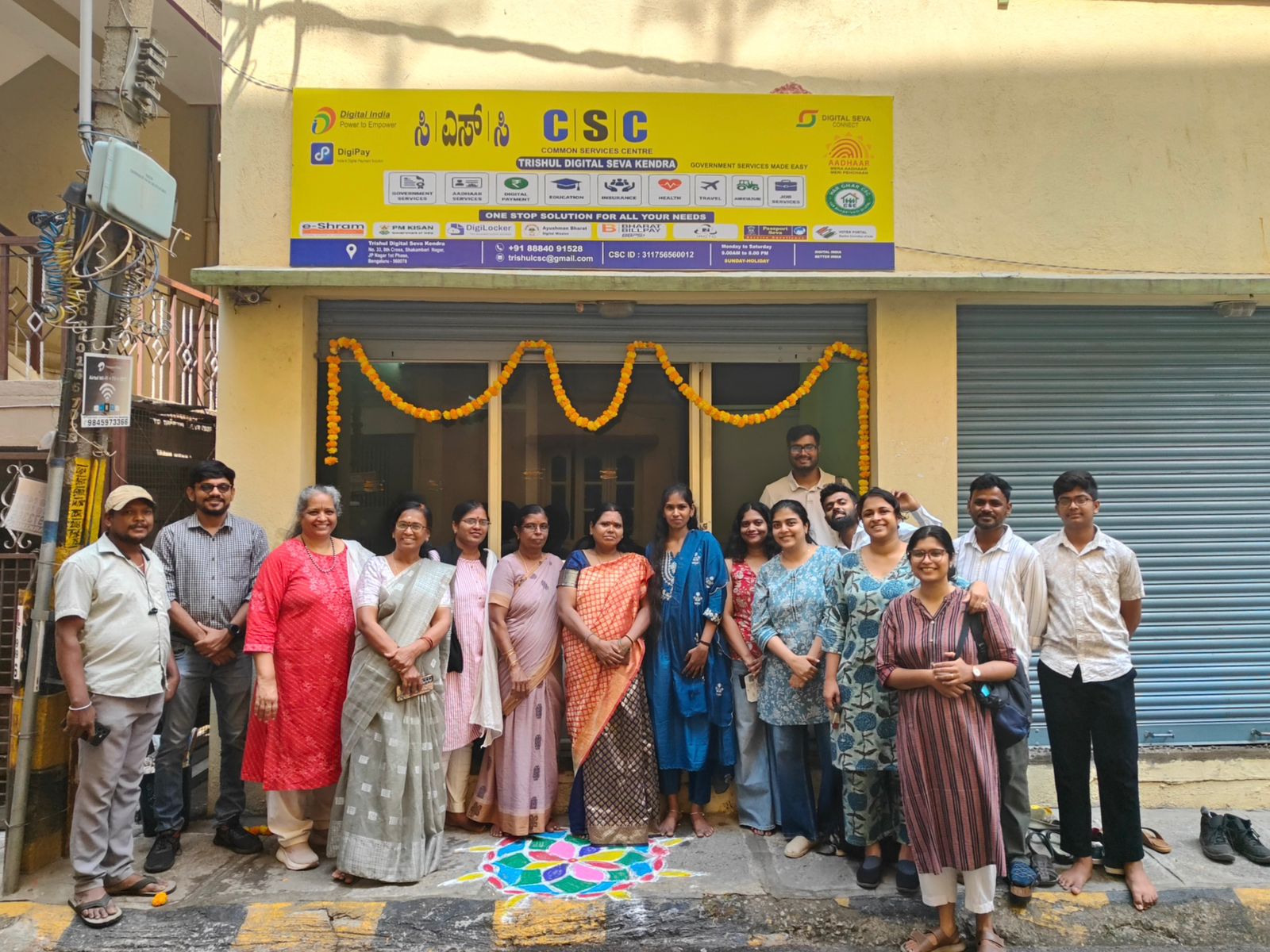
While improved access to services is an important outcome, the initiative is also exploring what community-led systems of support can look like in practice. As Sowbhagya, Director of Social Security at Hasiru Dala, explains:
“Many people and organisations came together to support this effort, including Saamuhika Shakti. This is the first step, and eventually, if such centres are handed over to the community, they can become permanent institutions. NGOs like us may come and go, but community-led systems will remain. That is what makes us truly happy.”
This vision lies at the heart of the CSC initiative. The goal is not only to help residents access services today, but also to strengthen the confidence, skills and leadership that enable communities to navigate these systems independently in the future.
“Earlier, we had to travel to different places, spend money on agents and still wait for months without knowing what would happen. Now, the CSC is right here in our community. The services are much more affordable, and we have someone we trust to help us. It has made things much easier for people like us.” — Lakshmidevamma, 56, Community Member, Banashankari
For Hasiru Dala, the CSC represents one step in a longer effort to build community agency and strengthen access to social security. For Saranya, it is an opportunity to support her community while demonstrating what becomes possible when local leadership is recognised and nurtured.
How the daughter of a waste picker became a Common Service Centre operator, strengthening her community's ability to navigate public systems and claim their rights.
By Anupriya, Project Lead and Arpitha MV, Social Media Officer, Hasiru Dala
For many waste picker families in Bengaluru, accessing government welfare schemes can be far more complicated than it should be.
Applying for a pension, updating a ration card, securing a scholarship or obtaining a health ID often requires navigating multiple offices, digital portals and documentation requirements. For families working long hours in the informal economy, each visit can mean lost wages, additional expenses and considerable uncertainty. A waste picker shared:
“New Aadhar card or correction cost Rs 100 at a cyber cafe and still we didn’t get any assurance of receiving it even after 3-4 months. New PAN Card cost Rs 400/- with agents and time taken could be ~3 months or more. For Caste and Income certificate ~Rs 3500 is being asked by agents.”
Over the years, Hasiru Dala has worked alongside waste picker communities to address these barriers. Through its work on livelihoods, social security and community leadership, the organisation has seen how difficult it can be for families to access services and entitlements that are meant to support them.
This understanding informed the creation of a new Common Service Centre (CSC) in Shakambari Nagar/Banashankari.
The CSC was established with a simple but important idea: what if access to welfare schemes and digital services could be centered within the community and facilitated by people from the community itself?
At the centre of this effort is Saranya, a young woman of 26, a graduate in B.E. from the waste picker community who now operates the CSC and supports residents in accessing a range of government and digital services. An aspiring civil servant herself, she represents a growing cohort of young community leaders stepping into roles that were previously inaccessible to many.
Saranya’s journey with Hasiru Dala goes back several years. Her mother had been associated with the organisation through the livelihood programs and community initiatives, making Hasiru Dala a familiar presence throughout her childhood. Over the years, Saranya herself received support through educational scholarships that helped her continue her studies and also provided guidance and financial support for her civil service exam preparations.
Growing up in the community, Saranya had seen first-hand how difficult it could be for families to navigate government systems. Accessing even basic services often depended on having the right information, documents, digital skills and time.
"Families often end up paying agents or third parties to access services that are meant to be free. Some are overcharged. Others are misled or sent back repeatedly because of incomplete paperwork. A single missed document can mean weeks of delay. For daily wage workers, every lost day also means lost income."
When Hasiru Dala launched a pilot initiative to train young people from waste picker families in digital literacy, entrepreneurship, leadership and access to government services, Saranya was among those who stepped forward. The programme pilot in Bangalore brought together around 25 young people from waste picker communities, equipping them with practical skills while encouraging them to become local resource persons within their own neighbourhoods.
Since June 2025, participants have undergone four digital literacy training sessions covering digital tools, access to government services and community leadership. In addition, a dedicated training programme focused on Common Service Centre (CSC) operations and CSC examination preparation. Saranya actively participated in these trainings and received handholding support for the CSC exam process, administrative procedures among others, helping her build the skills and confidence to establish and operate the centre.
Today, Saranya runs the CSC. “We are establishing a CSC especially for waste pickers, so they can access services at a lower cost compared to others and benefit from them,” she says. Through the centre, community members can seek support for pensions, ration cards, scholarships, health IDs and other welfare schemes.
Among the most frequently requested services are applications for Udhyam registrations (government-issued digital certificates legally recognising micro, small and medium enterprises), caste and income certificates, voter IDs, PAN cards (identity cards issued by the Income Tax Department of India that are mandatory for all taxpayers), e-Shram registrations (a Government of India initiative to support unorganised workers, allowing them to access social security schemes, welfare benefits and government assistance), Ayushman Bharat cards (digital health ID cards issued by the Indian government, helping eligible beneficiaries access health insurance coverage) and residential certificates (domicile IDs). By providing these services within the community, the CSC is helping community members navigate government systems more easily while reducing both the cost and time involved in accessing essential documents and entitlements.
Yet the value of the CSC extends beyond service delivery.
For many residents, navigating government systems can be intimidating. Processes are often unfamiliar and information is not always easy to access. Having someone from the community provide support can make these interactions easier and more approachable.
Because the centre is operated by a community member, waste pickers know where to go for help. Questions can be asked without hesitation and information can be shared through relationships that already exist. In this way, the CSC functions not only as a service point but also as a trusted community resource.
Saranya's experience also highlights the importance of creating pathways for young people to take on leadership roles within their own communities.
Too often, discussions around marginalised communities focus on what people lack. The CSC offers a different perspective. It demonstrates how community members can become facilitators, problem-solvers and connectors when they are given access to training, resources and opportunities.
This approach is central to Hasiru Dala's vision for strengthening community agency and leadership, and expanding access to social security systems. As Nalini Shekar, Co-founder of Hasiru Dala, explains:
“It's a good day for Hasiru Dala and Saamuhika Shakti. Saranya, who is now aspiring for civil services, has started this CSC centre. Our goal is to build the agency of the community so that they can independently access social security systems. This is our first initiative of this kind. We hope to establish similar centres in every district, run by members of the community for their own community, so that access to social security can continue to expand.”
Saranya's role at the CSC reflects this broader aspiration. Rather than positioning community members solely as beneficiaries of support, the initiative invests in local leadership and equips young people with the skills, knowledge and confidence to help others navigate systems that are often difficult to access. The CSC pilot is expected to reach more than 500 community members across Bengaluru.
While improved access to services is an important outcome, the initiative is also exploring what community-led systems of support can look like in practice. As Sowbhagya, Director of Social Security at Hasiru Dala, explains:
“Many people and organisations came together to support this effort, including Saamuhika Shakti. This is the first step, and eventually, if such centres are handed over to the community, they can become permanent institutions. NGOs like us may come and go, but community-led systems will remain. That is what makes us truly happy.”
This vision lies at the heart of the CSC initiative. The goal is not only to help residents access services today, but also to strengthen the confidence, skills and leadership that enable communities to navigate these systems independently in the future.
“Earlier, we had to travel to different places, spend money on agents and still wait for months without knowing what would happen. Now, the CSC is right here in our community. The services are much more affordable, and we have someone we trust to help us. It has made things much easier for people like us.” — Lakshmidevamma, 56, Community Member, Banashankari
For Hasiru Dala, the CSC represents one step in a longer effort to build community agency and strengthen access to social security. For Saranya, it is an opportunity to support her community while demonstrating what becomes possible when local leadership is recognised and nurtured.


